
Product line
Sunflower Oil Manufacturers, Suppliers and Exporters
Refine Sunflower Oil is a Ukrainian edible oil exporter, founded in 2000 and based in Kyiv, supplying crude and refined (RBD) sunflower oil to importers, bottlers and food manufacturers worldwide. This page covers both grades, the packaging formats, the trade terms and documentation involved, and what to put in a quotation request.
What we supply, and who buys it
We supply sunflower oil in two grades, crude and refined (RBD), to businesses buying by the container or the tank rather than off a shelf. Orders are placed against a contract, shipped from Ukraine, and delivered FOB or CIF to a named port under Incoterms 2020.
- Importers and trading houses placing repeat consignments into a market.
- Bottlers and repackers filling retail or catering packs, often under their own label.
- Wholesalers and distributors supplying catering and retail channels in their own territory.
- Food manufacturers using sunflower oil as a frying medium or a formulation ingredient.
- Refiners and crushers buying crude oil as refinery feedstock.
- Feed and technical processors using crude oil as a raw-material input.
We sell as a direct supplier and exporter rather than as a marketplace listing, so the contract, the certificate of analysis and the shipping documents all come from one party. Sunflower oil sits inside a wider range: we also supply soybean, canola (rapeseed), corn, palm, palm kernel, olive, coconut, sesame and peanut oils, and used cooking oil. Non-GMO grades are available on request; our food safety systems are certified to HACCP and ISO 22000.
Crude or refined (RBD): which grade to buy
Buy crude sunflower oil if you intend to refine it yourself, and refined (RBD) oil if it is going straight into a food product, a bottle or a fryer. The decision turns on where the refining cost and the quality risk sit in your process, not on the oil itself.
When crude sunflower oil is the right buy
- You run a refinery and want neutralising, bleaching, winterising and deodorising in-house.
- You are blending or tolling for third parties and need an unfinished input.
- The end use is technical or feed rather than direct human consumption.
- Your plant can handle gums and test incoming oil before it enters the process.
When refined (RBD) sunflower oil is the right buy
- The oil goes directly into a finished food product, a retail pack or a commercial fryer.
- You need a neutral taste, odour and appearance your own customers will not notice.
- You have no refining capacity and no wish to take on the quality risk of processing.
- You are bottling under your own label and the oil has to arrive ready to fill.
Both grades ship from the same origin under the same contract and documentation framework, so a buyer can move between them without renegotiating terms.
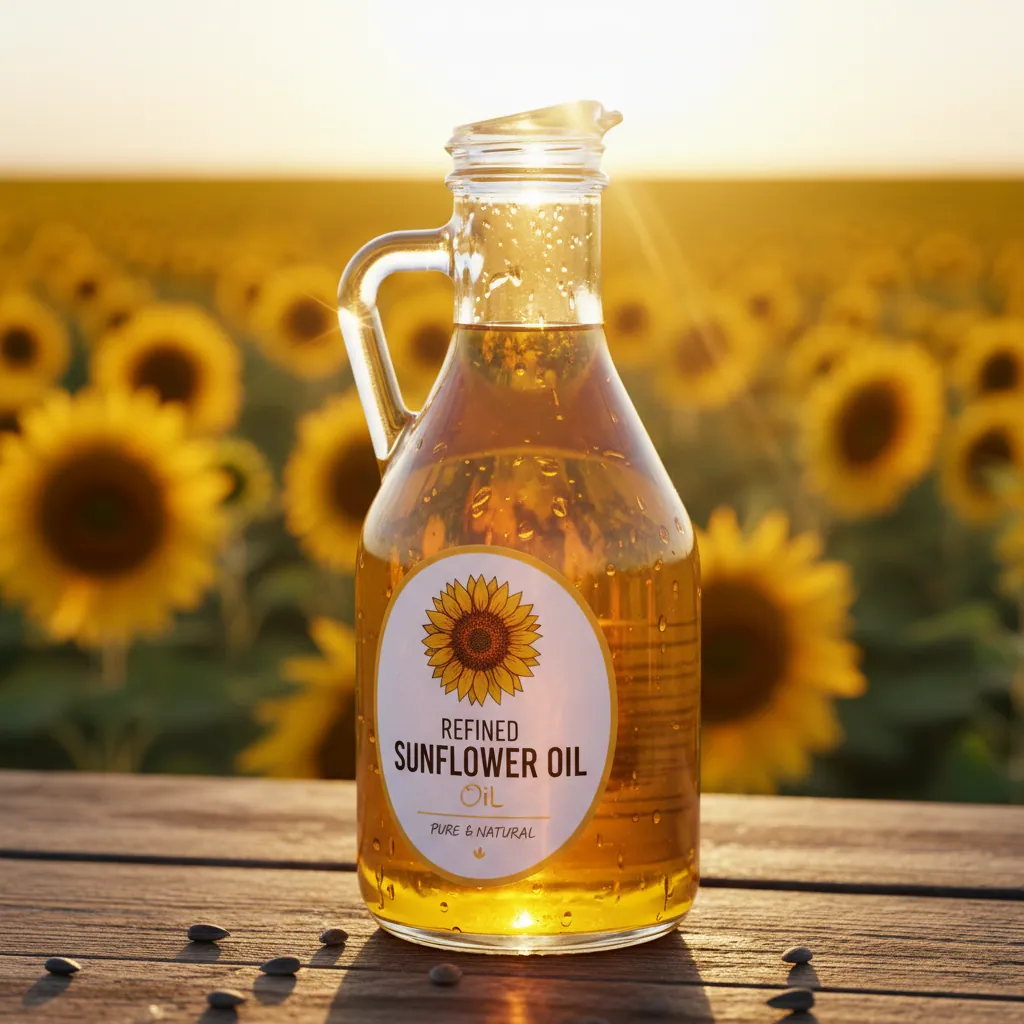 Refined Sunflower Oil (RBD)Ready to bottle, fry or formulate. Flexitank to PET bottle.
 Crude Sunflower OilRefinery feedstock for crushers, refiners and feed producers.
 All Products and ServicesEvery bulk edible oil we export, plus bottling and logistics.
Packaging formats, and when each one fits
Packaging follows how much oil is moving and what the receiving end can handle. Bulk formats are the cheapest way to move oil but need tankage or a transfer point; packed formats cost more per litre and need neither. We ship flexitank, ISO tank, 190 kg drum, IBC and PET bottle.
- Flexitank. A single-use liner that turns a standard shipping container into a bulk tank. The usual choice when one container moves as a single lot and the buyer can pump and store it on arrival.
- ISO tank. A reusable tank container, for bulk movements where the receiver has dedicated edible oil tankage or the same route repeats.
- 190 kg drum. Steel drums suit buyers with no bulk receiving facilities, inland destinations reached by road, and markets where oil is resold in the drum.
- IBC. Intermediate bulk containers are the middle ground: stackable, forklift-handled, easy to meter into a production line without a pump station.
- PET bottles. Retail and catering packs, cartoned and palletised, for distributors and private-label programmes.
The destination decides as much as the volume. A port with edible oil tank storage is what makes flexitank or ISO tank economics work; a buyer trucking inland, or splitting a consignment across several customers, is often better served by drums or IBCs. Tell us the port and what you can receive, and we will say which formats are worth quoting.
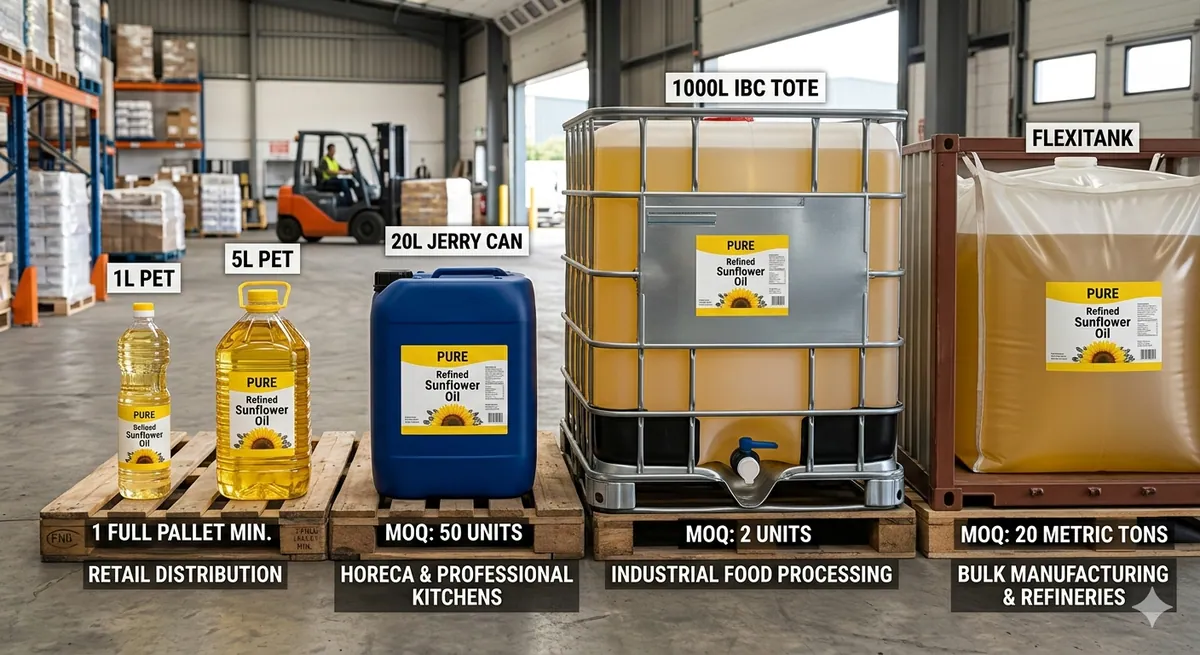
- Flexitank vs drum vs IBCSide-by-side comparison of container loading options.
- Shipping in flexitanksHow flexitank loading works and where it saves money.
- Shipping in ISO tanksStandards, costs and how an ISO tank booking is made.
- Shipping in drumsWhen drum packing is the right call for a consignment.
- Shipping in IBCsIntermediate bulk containers for mid-volume buyers.
- PET bottles and private labelBottling for retailers and own-brand programmes.
FOB or CIF: choosing the trade term
FOB puts ocean freight and marine insurance in your hands; CIF puts them in ours and folds them into the price. We quote either, under Incoterms 2020, to a port you name.
FOB, and when it suits a buyer
Under FOB the oil becomes yours once it is loaded at the port of shipment: you book the vessel, arrange insurance and carry the risk from there. FOB suits buyers who already hold freight contracts, because they can usually better a seller's rate and can see what the freight costs instead of having it bundled in.
CIF, and when it suits a buyer
Under CIF we arrange carriage and insurance to the destination port you name and quote one landed figure. CIF suits buyers who want a single comparable number from every supplier, or who would rather not manage a vessel booking on another continent. Risk still passes at loading, which is why the insurance matters.
Whichever term you choose, the port has to be named in the contract: “CIF Europe” is not a price. Payment is by bank transfer (T/T) in EUR or USD, and lead time is typically 7 to 14 days from order confirmation.
Documentation that travels with a consignment
Every consignment ships with a certificate of analysis and a certificate of origin. The certificate of analysis records what was tested on the lot you are receiving; the certificate of origin establishes where the oil came from for customs and tariff purposes.
Beyond those two, an edible oil shipment file normally carries the commercial invoice, packing list and bill of lading, plus whatever your import regime adds: a health or free-sale certificate, a phytosanitary document, or a country-specific consular form. Import requirements are set by the destination, not the supplier, so confirm your list with your broker before the contract is signed. Third-party inspection at loading can be contracted.
- FOB vs CIF comparedWhich trade term actually leaves you better off.
- Incoterms for oil buyersFOB, CIF, CFR and DAP explained for edible oil.
- Payment termsT/T, letters of credit, D/P and D/A for oil contracts.
- Export documentationWhat every edible oil shipment needs on paper.
What to specify when you request a quotation
A request that answers the points below comes back as a firm offer rather than a list of questions. Nothing below is filled in on your behalf: these are the parameters to state when requesting a quotation, and the limits are yours to set from your own specification and your market's rules.
- Grade. Crude or refined (RBD), and whether you require a non-GMO grade.
- Quality limits. The parameters your specification controls — free fatty acid or acid value, peroxide value, moisture and volatile matter, insoluble impurities, colour, and anything else your regulator or your customer imposes — each with the limit you need. State them rather than assuming a house standard.
- Volume and schedule. The quantity per shipment, and whether this is a single consignment or a running contract.
- Packaging. Flexitank, ISO tank, 190 kg drum, IBC or PET bottle, and for packed goods the pack size and carton and pallet configuration.
- Labelling. Neutral packaging, your own artwork or a private-label programme, with the declarations your destination requires.
- Destination. The named port of discharge, and the inland destination if that changes the packaging decision.
- Trade term. FOB or CIF, under Incoterms 2020.
- Documentation and inspection. Anything beyond the certificate of analysis and certificate of origin, including inspection at loading.
What a certificate of analysis actually tells you
A certificate of analysis is a lot-specific test report, not a sales document: it describes the oil you are receiving rather than the oil a supplier generally sells. For sunflower oil it usually reports free fatty acid or acid value, peroxide value, moisture and volatile matter, insoluble impurities and colour, with the test method named beside each result. Check two things every time: that the lot reference matches your consignment, and that the limits printed on it are the limits written into your contract rather than a laboratory's defaults.
- How to read a COALine by line through a sunflower oil certificate of analysis.
- Choosing a gradeMatching crude or refined oil to what your business does.
- Crude vs RBD in bulkWhen each grade is the lower total cost to own.
- Non-GMO sourcingHow non-GMO status is documented and verified.
- HACCP for oil suppliersWhat the standard requires and how to check it.
- Importing step by stepThe full sequence for a first-time bulk importer.
Markets we serve
We ship worldwide from Ukraine. Established destinations include Spain, Germany, the Netherlands, Belgium, the United States, Brazil, Venezuela, the United Arab Emirates and Dubai, Australia, Hong Kong, Egypt, Libya, Russia and the Ukrainian domestic market.
Origin shapes the logistics: Black Sea loading, road and rail for nearby European destinations, deep-sea routing for everything else. If your market is not listed above it is still worth asking: the constraint is routing and documentation, not geography.
- Sourcing from UkraineHow to buy from the world's largest sunflower oil exporter.
- Global trade flowsWhere sunflower oil comes from and where it goes.
- Supplier audit checklistTwenty questions to ask before you sign a contract.
- Vetting a supplierThe red flags and green flags that actually matter.
Working with Refine Sunflower Oil
Refine Sunflower Oil has exported edible oils since 2000 and is based at Gareth Jones St 8, 04119 Kyiv, Ukraine. Enquiries and quotation requests are handled by email, at export@refinesunfloweroil.com. Send the grade, volume, packaging and destination port, and the reply will be an FOB or CIF offer.
- Request a QuoteSend your grade, volume, packaging and destination port.
- About the companyWho we are, where we operate and since when.
- Products and servicesEvery oil we export, bottling and export logistics.
- Buyer's guidesSpecifications, logistics, documentation and market guides.
See how we pack and who we supply
Two things buyers usually ask to see before a first order: what the goods actually look like leaving our hands, and who has bought before.
Supply & shipping terms
- Incoterms
- FOB or CIF, named port, Incoterms 2020
- Payment
- Bank transfer (T/T) in EUR or USD
- Lead time
- Typically 7–14 days from order confirmation
- Documentation
- Certificate of analysis, certificate of origin, full export documents
- Food safety
- HACCP and ISO 22000
- Area served
- Worldwide
Specifications are indicative. Contract terms and a certificate of analysis are issued per consignment.