
Product line
Bulk Refined Sunflower Oil (RBD) — Supplier and Exporter
Bulk sunflower oil in the refined (RBD) grade is the neutral, pale, heat-stable oil that food manufacturers, bottlers and foodservice distributors buy by the container or the tank. We refine it in Ukraine and export it worldwide. This page is written for the buyer running that evaluation: what the grade is, which fatty-acid type to ask for, what belongs in a request for quotation, which packing format suits which volume and destination, and the trade terms we quote on.
What bulk refined sunflower oil is, and who buys it
Refined sunflower oil — written RBD for refined, bleached and deodorised — is sunflower oil that has had its free fatty acids, colour bodies and volatile aroma compounds removed, leaving a clear, pale, effectively flavourless oil that is ready for food use without further processing. Buying it in bulk means buying container or tank quantities against a contract and a certificate of analysis rather than off a wholesaler's shelf.
The buyers we supply in this grade fall into a handful of recognisable groups:
- Food manufacturers putting the oil into mayonnaise and emulsified dressings, sauces, bakery, snack frying, canning and ready meals.
- Bottlers and private-label packers filling PET for retail and for food-service catering packs.
- Foodservice distributors and commercial frying operations buying frying oil by the pallet or the drum.
- Blenders producing vegetable oil blends, margarines and shortenings where sunflower is one component of a fat formulation.
- Importers and regional distributors breaking bulk and reselling into local wholesale markets.
We sell as the manufacturer and exporter rather than through a marketplace listing, so the contract, the specification confirmation and the certificate of analysis all come from the party that loaded the oil.
What refining does, and why it matters on your line
Refining runs in three stages. Neutralisation removes free fatty acids, bleaching removes colour bodies and trace metals, and deodorisation strips the volatile compounds that carry smell and taste. A sunflower refining line normally adds winterisation, which chills the oil and filters out waxes so that it stays bright rather than clouding in cold storage. What comes out is clear, pale gold and neutral — which is precisely why it is the default for frying, baking, sauces, canning and any application where the finished product should taste of itself rather than of the oil.
Sunflower oil is naturally low in saturated fat, free of cholesterol as all vegetable oils are, and a source of vitamin E. For packers, that combination is what keeps it attractive on a nutrition panel compared with tropical oils and animal fats.
Linoleic, mid-oleic or high oleic: the choice inside the refined grade
The refined grade is not one oil but three fatty-acid types, and which one you want depends chiefly on how long the oil has to sit at frying temperature. Standard linoleic sunflower oil is the commodity type and the usual choice for bottling, bakery, dressings and general food manufacturing. High oleic sunflower oil carries a fatty-acid profile shifted towards oleic acid, which makes it more resistant to oxidation and the usual choice for extended-life industrial frying, snack coating and products that need a long ambient shelf life. Mid-oleic sits between the two.
This matters commercially as well as technically. The Codex Alimentarius standard for named vegetable oils treats sunflowerseed oil, high oleic acid sunflowerseed oil and mid-oleic acid sunflowerseed oil as three separately named oils with their own composition tables. An enquiry that says only "sunflower oil" leaves the most expensive variable in the quotation undefined, so name the type you want.
- How refining actually worksDegumming through deodorisation, stage by stage
- Smoke point chartPublished smoke and flash points across 45 oils and grades
Codex reference figures for refined sunflower oil
The figures below are the limits set by the Codex Alimentarius standard for named vegetable oils (CODEX STAN 210-1999), the internationally accepted reference for sunflower oil. They describe the standard, not a single consignment: the certificate of analysis issued with your shipment is what governs, and your own specification may be tighter.
- Relative density (20°C/water at 20°C): 0.918 – 0.923
- Refractive index (ND 40°C): 1.461 – 1.468
- Saponification value: 188 – 194 mg KOH/g oil
- Iodine value (Wijs): 118 – 141
- Unsaponifiable matter: not more than 15 g/kg
- Acid value, refined oils: not more than 0.6 mg KOH/g
- Peroxide value, refined oils: up to 10 milliequivalents of active oxygen per kg
Tell us the limits your specification requires and we will confirm against them before loading. Non-GMO grades are available on request.
What to specify when you request a quotation
A request that answers the points below comes back as a firm offer rather than a list of questions. Every item on it is something the buyer sets, not something a supplier can assume.
- Grade and fatty-acid type: refined (RBD), and whether linoleic, mid-oleic or high oleic.
- Volume for the first shipment, and whether you are pricing a spot parcel or a repeat contract.
- Packing format, and for packed goods the fill size and whether you need your own label.
- Destination port, and the Incoterm you want to be quoted on.
- The parameters your specification holds, each with the laboratory method named, so that two offers can be compared on the same basis.
- Whether non-GMO documentation is required for your market.
- Whether you intend to appoint an inspector at loading, and at whose cost.
Packing formats, and which volume each suits
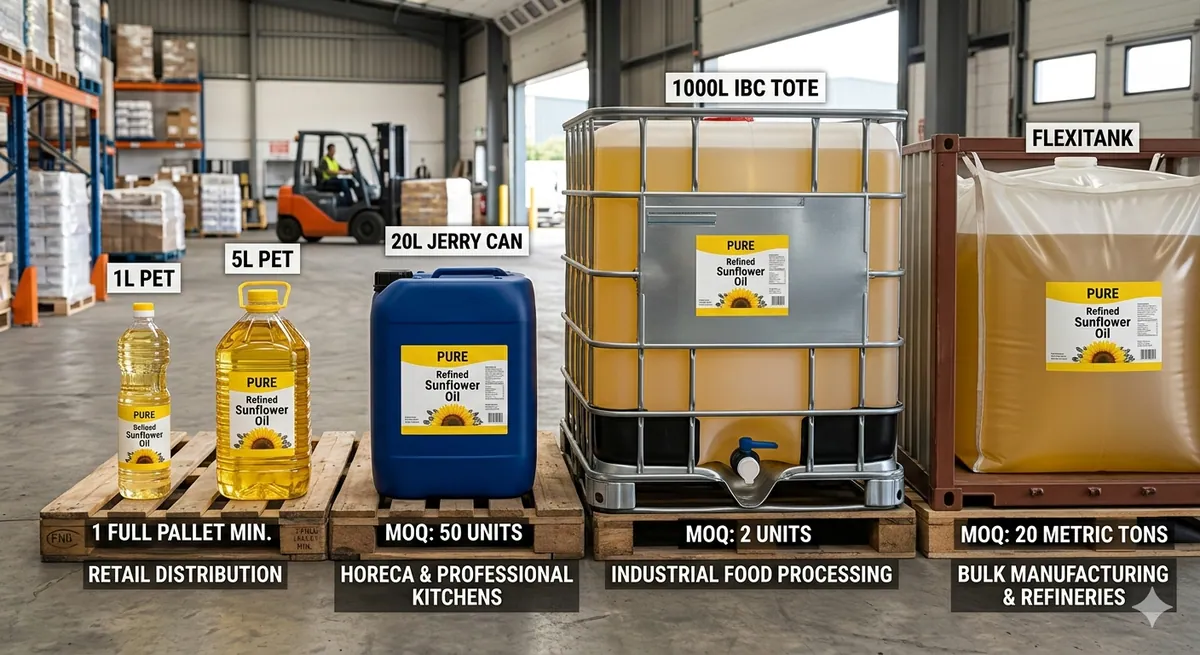
Packing follows how much oil is moving and what the receiving end can discharge. Bulk formats are the cheapest way to move a tonne and need tank facilities at destination; packed formats cost more per tonne and need only a forklift.
- Flexitank. A single-use liner that turns a standard shipping container into a bulk tank. The usual choice for a full container load into a port with edible oil handling.
- ISO tank. A reusable stainless steel tank container, suited to repeat lanes and to receivers with dedicated discharge equipment.
- Drums of 190 kg. Granular, stackable and handled anywhere there is a forklift. The usual format for frying oil going to foodservice and for first trial lots.
- IBC. Palletised intermediate bulk containers for part loads and for sites with no tank intake.
- PET bottles. For buyers purchasing finished retail packs rather than bulk oil, including private-label fills.
The destination decides as much as the volume does. A port with edible oil tank storage is what makes flexitank or ISO tank economic; without it, the saving per tonne disappears into road tankering and the packed formats win. Name the discharge port and we will say which formats are practical on that lane.
- Flexitank, drum or IBCThe three bulk formats compared side by side
- FOB or CIFWhich trade term actually leaves a buyer better off
- Request a quotationSend grade, volume, packing and destination port
FOB or CIF, payment and lead time
We quote FOB or CIF to a named port under Incoterms 2020, and the choice changes who carries freight and marine insurance rather than changing the oil. Under FOB you book the vessel and carry carriage and insurance from the port of shipment, which suits buyers with their own freight contracts. Under CIF we arrange carriage and insurance to the port you name and quote a single landed figure, which suits buyers who would rather compare one number. Either way the port has to be named in the contract, because a region is not a price.
Payment is by bank transfer (T/T) in EUR or USD. Lead time is typically 7 to 14 days from order confirmation, subject to packing format and loading window.
Documentation that travels with each consignment
Every consignment ships with a certificate of analysis and a certificate of origin. The certificate of analysis is lot-specific and reports the parameters agreed in the contract, which is why the limits you set at enquiry stage are the limits you can hold a shipment to. The certificate of origin establishes where the oil came from for customs purposes.
Alongside those, the shipment file normally carries the commercial invoice, the packing list and the bill of lading. Where your purchase terms require independent verification, you may appoint a third-party inspector — SGS, Intertek and Bureau Veritas are the names buyers most often use — to attend sampling at loading at your own cost; the appointment is yours, not ours, which is what keeps the result independent.
Buying direct from the refinery in Ukraine
We manufacture and refine edible oil in Ukraine, the world's largest sunflower oil exporting origin, and have been exporting since 2000. Our operation runs to HACCP and ISO 22000 food safety standards, and non-GMO grades are available on request. Buying at origin shortens the chain between the press and your tank, which matters most on the two things buyers dispute later: whose certificate of analysis describes the oil, and who can actually change the loading plan if your schedule moves.
How to enquire
Refine Sunflower Oil is based at Gareth Jones St 8, 04119 Kyiv, Ukraine. Write to export@refinesunfloweroil.com, or use the contact form, with the grade and fatty-acid type, the volume, the packing format, the destination port and the Incoterm you want quoted, together with the specification limits you work to. Email is the quickest route to a firm offer.
Related grades
If you refine in-house, the crude grade is the one to price instead. The sunflower oil overview sets out both alongside the packing formats we load.
Supply & shipping terms
- Incoterms
- FOB or CIF, named port, Incoterms 2020
- Payment
- Bank transfer (T/T) in EUR or USD
- Lead time
- Typically 7–14 days from order confirmation
- Documentation
- Certificate of analysis, certificate of origin, full export documents
- Food safety
- HACCP and ISO 22000
- Area served
- Worldwide
Specifications are indicative. Contract terms and a certificate of analysis are issued per consignment.