
Product line
Bulk Crude Corn Oil — Crude Maize Oil Supplier
Crude corn oil — crude maize oil in most of the world — is unrefined oil taken from the germ of the maize kernel and sold to buyers who refine or process it themselves. We produce it in Ukraine and export it against the limits a refiner sets. Demand for this grade is narrow and technical, so this page stays on what a feedstock buyer actually asks: what the grade is, how it differs from distillers corn oil, what to specify, and how it ships.
What crude corn oil is
Crude maize oil is pressed and extracted from maize germ, the embryo separated out of the kernel during milling. The Codex Alimentarius standard for named vegetable oils (CODEX STAN 210-1999) defines it exactly that way — maize oil, also called corn oil, derived from maize germ, the embryos of Zea mays L. — and because the germ is only a small fraction of the kernel, corn oil is a co-product of milling rather than the reason the crop is grown.
Crude means unrefined. The oil still carries its phosphatides, free fatty acids, waxes and colour bodies, which is what a refiner is buying: the neutralising, bleaching, winterising and deodorising margin stays in its own plant. Maize oil also carries waxes that cloud it at low temperature, so dewaxing or winterising is normally part of the refining route.
Crude maize oil is not distillers corn oil
These are two different products traded under confusingly similar names, and buying one when you wanted the other is the commonest mistake in this market. Crude maize oil, the grade on this page, is a food-chain oil extracted from maize germ at a mill. Distillers corn oil, usually abbreviated DCO, is recovered from the stillage at a dry-mill ethanol plant after fermentation, and is traded mainly as a biodiesel feedstock and a feed ingredient rather than as a refinery input for food.
The two are priced on different curves, specified on different parameters and in many markets regulated differently. If your enquiry says corn oil and your process expects DCO, say so explicitly, because we supply the germ-derived grade.
Who buys it
- Edible oil refiners taking it as feedstock for a food-grade refined corn oil output.
- Oleochemical and technical processors using unrefined oil as a raw-material input.
- Feed compounders using it as a dense source of energy and linoleic acid.
- Biofuel producers using it as a lipid feedstock, subject to the scheme point below.
On the biofuel side, check the sustainability scheme before anything else. Renewable fuel producers in the European Union are routinely obliged to buy against a recognised voluntary scheme, most commonly ISCC, for a volume to count towards a national obligation. We do not hold ISCC certification. Our food safety systems are certified to HACCP and ISO 22000, and those are the certifications we hold.
Codex reference parameters for maize oil
The ranges below belong to the Codex Alimentarius standard for named vegetable oils (CODEX STAN 210-1999). They are identity characteristics, used by a laboratory to confirm that an oil is what it is sold as, and they describe the standard rather than a consignment. The certificate of analysis issued with your shipment is what governs, and your own specification may be tighter.
- Relative density (20°C/water at 20°C): 0.917 – 0.925
- Refractive index (ND 40°C): 1.465 – 1.468
- Saponification value: 187 – 195 mg KOH/g oil
- Iodine value: 103 – 135
- Unsaponifiable matter: not more than 28 g/kg
Note what the standard does not give you. Its acid value and peroxide value limits are written for refined oils and for cold pressed and virgin oils, not for crude oil destined for a refinery, so there is no international ceiling on free fatty acid in a crude contract. That limit is yours to set, and it needs to be written down.
What to specify in a quotation request
We publish no house figures for this grade. You state the limits your process requires, we confirm against them before loading, and the certificate of analysis reports what was loaded. An enquiry covering the points below comes back as a firm offer rather than a list of questions.
- Free fatty acid or acid value: the maximum your refining or pretreatment route can carry.
- Phosphorus, with the test method named, which settles how far the oil has been degummed.
- Moisture and volatile matter, and insoluble impurities, each with a limit.
- Whether the end use is food, feed or technical, and any waxes or winterising requirement.
- Volume per shipment, and whether this is a spot lot or a running contract.
- Packing format, destination port and trade term, FOB or CIF.
- Whether you will appoint an independent surveyor at loading, and what they are to test.
Packing, terms and documents
Crude oil moves in bulk wherever the destination can take it: flexitank for a full container as one lot, ISO tank where the receiver has dedicated tankage or the lane repeats. Where bulk discharge is not available we load 190 kg drums or IBCs, which cost more per tonne and need nothing at the other end beyond a forklift.
We quote FOB or CIF to a named port under Incoterms 2020. Payment is by bank transfer (T/T) in EUR or USD, and lead time is typically 7 to 14 days from order confirmation. A certificate of analysis and a certificate of origin ship with every consignment, alongside the commercial invoice, packing list and bill of lading; safety data sheets are provided on request. Independent inspection at loading by SGS, Intertek, Bureau Veritas or another surveyor you appoint can be arranged at your cost.
Enquiries go to export@refinesunfloweroil.com or through the contact form. Refine Sunflower Oil has exported edible oils since 2000 from Gareth Jones St 8, 04119 Kyiv, Ukraine.
- Ask for an offerVolume, limits, packing format and destination port
- Crude rapeseed (canola) oilThe other crude seed oil refiners pair with this one
- Export documentationWhat travels with an edible oil shipment on paper
- Full product rangeEvery bulk oil we export, crude and refined
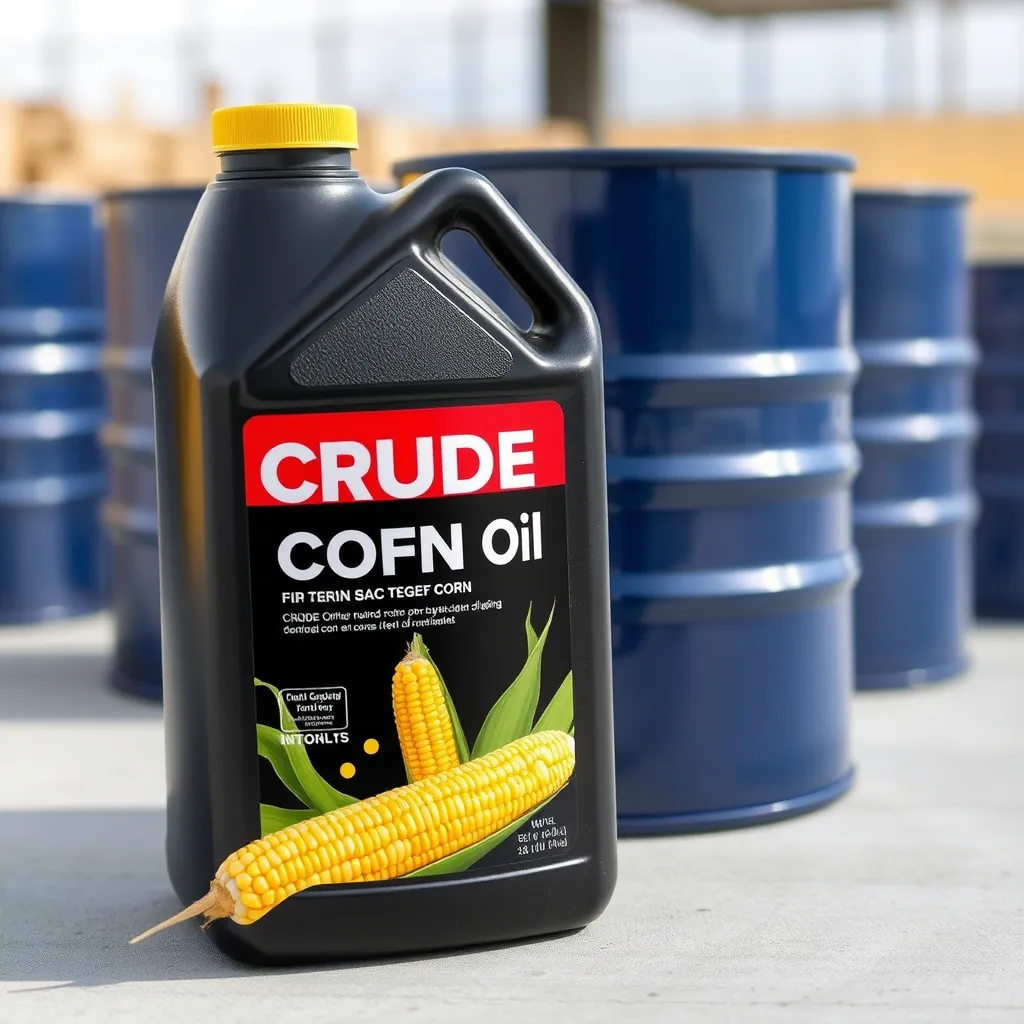
The refined counterpart
Food manufacturers normally buy the refined grade; this crude maize oil is for buyers with refining capacity of their own.
Supply & shipping terms
- Incoterms
- FOB or CIF, named port, Incoterms 2020
- Payment
- Bank transfer (T/T) in EUR or USD
- Lead time
- Typically 7–14 days from order confirmation
- Documentation
- Certificate of analysis, certificate of origin, full export documents
- Food safety
- HACCP and ISO 22000
- Area served
- Worldwide
Specifications are indicative. Contract terms and a certificate of analysis are issued per consignment.